
Last updated September 20, 2026
Full 25-point door and opener safety check with every visit - springs, cables, rollers, tracks, and your LiftMaster or Chamberlain opener included
You get a price before we start. It does not change when the truck arrives.
 Before
 After
After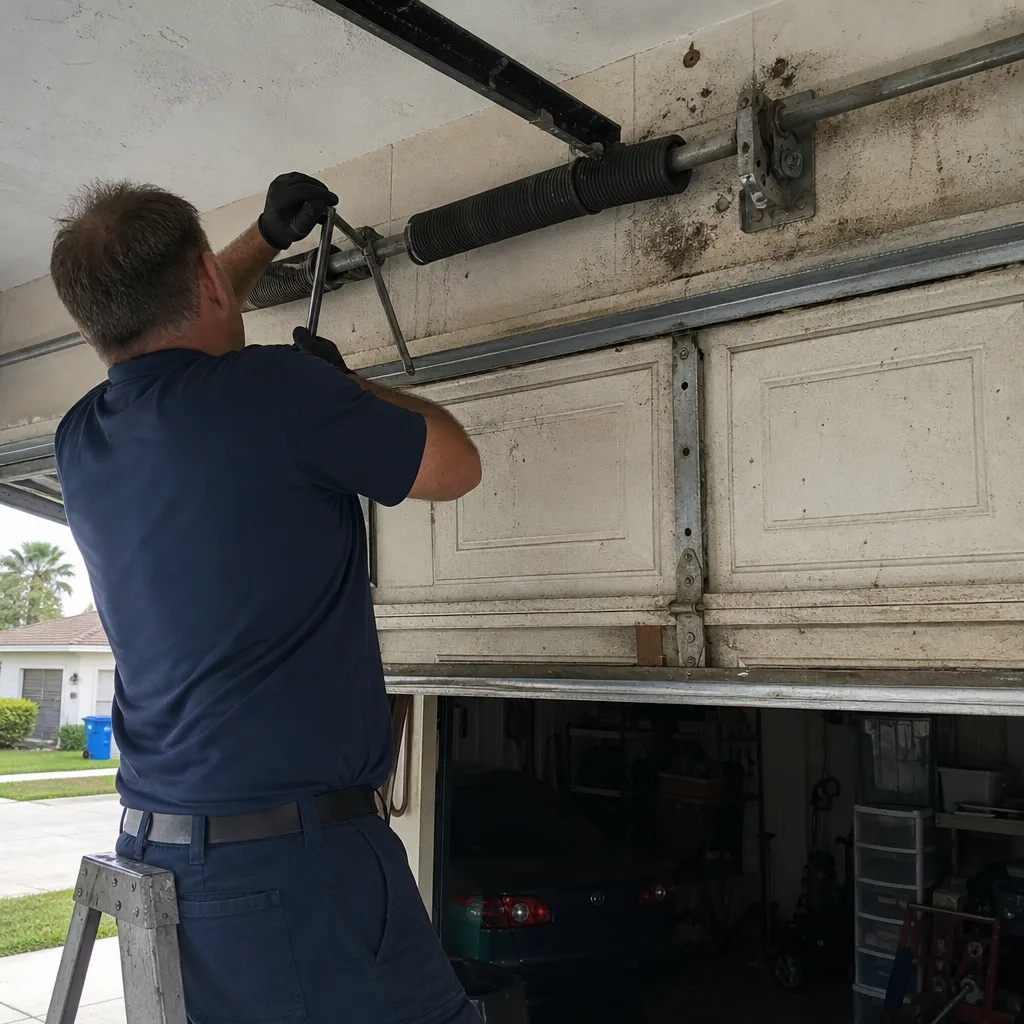 Before
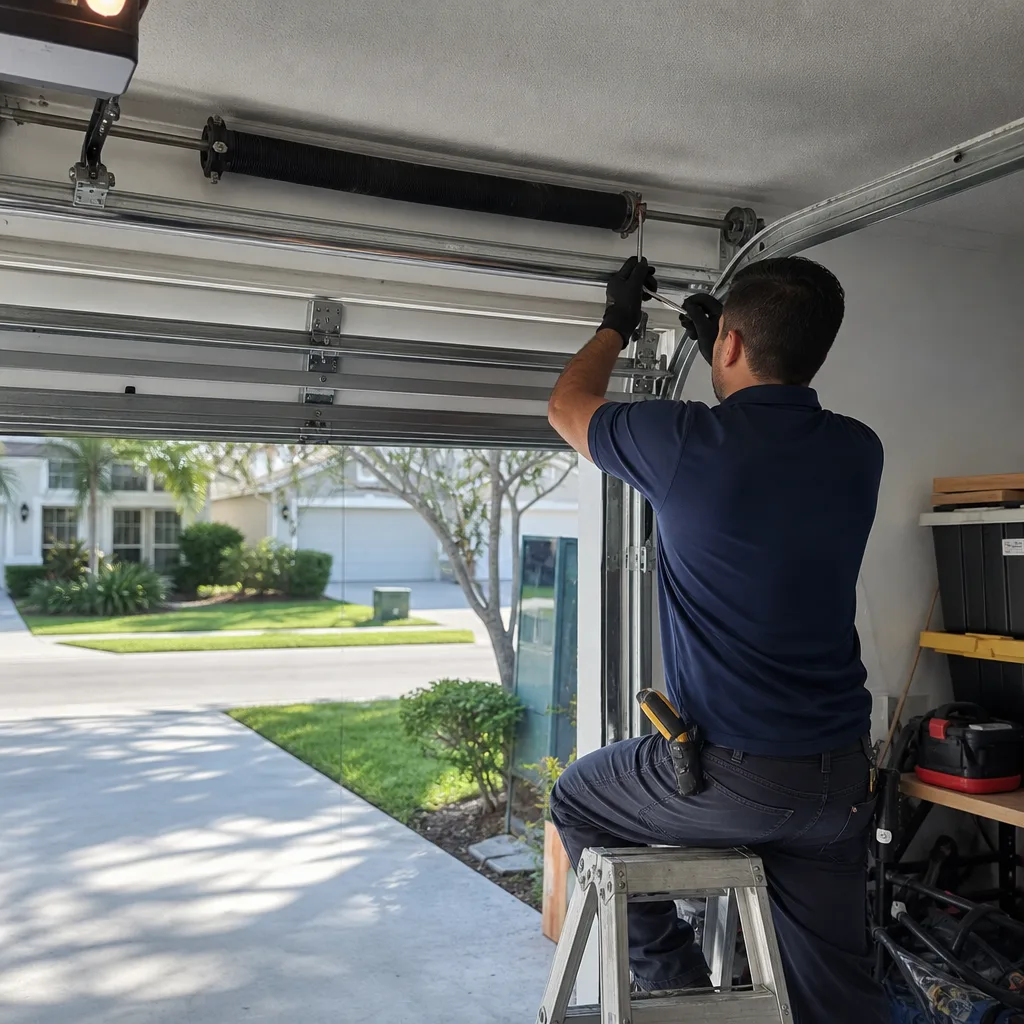 After
After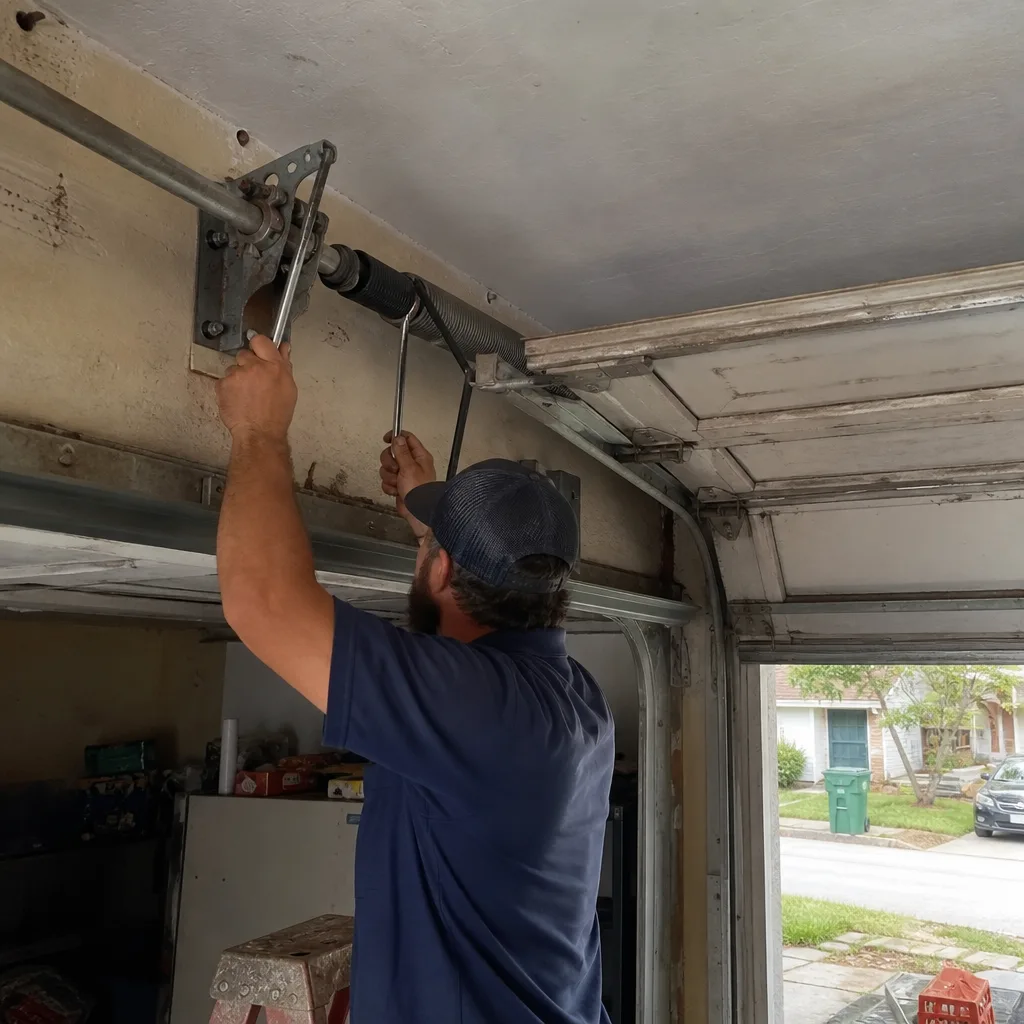 Before
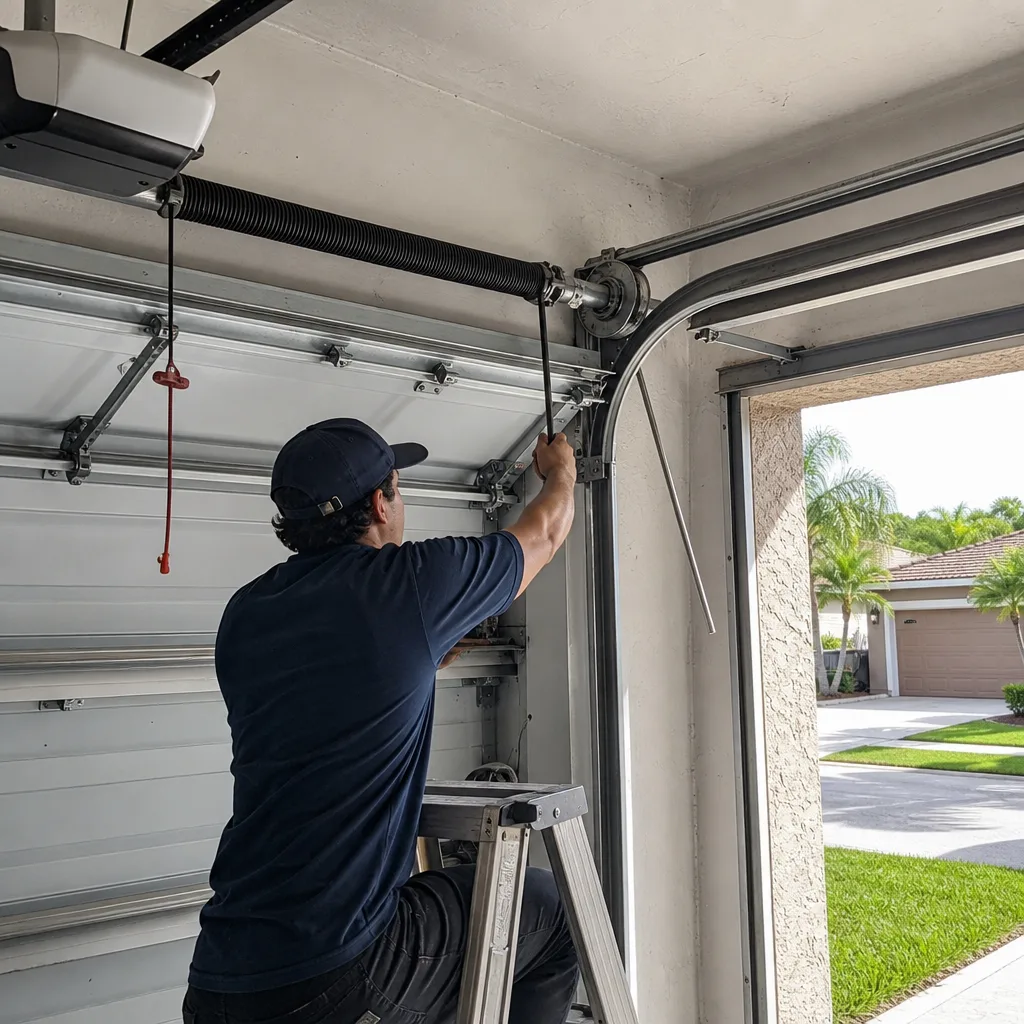 After
AfterGarage Door Warning Signs: A Pembroke Pines Homeowner’s Reference Guide
Most garage doors don’t fail without warning. They telegraph the failure days or weeks in advance through specific sounds, movements, and visible wear patterns that homeowners either don’t notice or don’t know how to read. In Pembroke Pines, where humidity and salt air accelerate corrosion on metal components, these warning signs appear earlier and progress faster than national averages predict. This guide names each symptom, identifies the exact component responsible, and assigns a realistic repair cost range so you can triage the problem before it becomes an emergency. For a broader look at garage door systems in this area, see The Complete Guide to Garage Door in Pembroke Pines. You’ll learn which signs give you weeks of lead time and which ones mean you should stop using the door tonight.
Quick Answer
The most common garage door warning signs in Pembroke Pines are grinding or squealing sounds during operation, a door that hesitates or reverses mid-cycle, visible rust or fraying on cables and springs, and a door that sits unevenly in the opening. A squeal usually points to worn rollers or dry bearings, while a frayed cable strand or cracked spring coil signals imminent failure that requires professional repair within days, not weeks. Most of these repairs cost between $120 and $380 when caught early, but ignoring them can turn a $40 roller replacement into a $650 spring and cable job. If you’re planning to hire help, our How to Hire a Garage Door Contractor in Pembroke Pines: A Step-by-Step Guide walks you through the process.
Table of Contents
- Seven Sounds Your Garage Door Makes and What They Mean
- Movement Warning Signs: Hesitation, Reversal, and Uneven Travel
- Visible Wear: Rust, Fraying, and Cracks You Can Spot in Five Minutes
- Lead Time: Which Warning Signs Give You Weeks vs. Days
- Why Pembroke Pines Humidity Accelerates Garage Door Wear
- How to Photograph a Warning Sign for Remote Diagnosis
- Three Symptoms Homeowners Misattribute to the Opener
- What Each Warning Sign Costs to Fix in Pembroke Pines
BeforeAfterSeven Sounds Your Garage Door Makes and What They Mean
Every sound a garage door makes comes from a specific component doing something it shouldn’t. Here’s the mapping, matched to the part that generates it. We’ve included the likely culprit and whether it’s a do-it-today or monitor-it problem.
1. A high-pitched squeal that follows the door’s movement. This is almost always the rollers, specifically the bearings inside the roller wheels traveling along the track. In Pembroke Pines, the humidity works its way into unsealed roller bearings and displaces the grease, which leaves metal on metal. The repair is straightforward: replace all rollers with sealed-bearing nylon rollers. Cost range: $85 to $160 including parts and labor.
2. A metallic grinding sound when the door moves. Grinding differs from squealing. It’s lower pitched and sounds like metal being dragged. The usual culprits are the hinges at the door’s joints or a track that has drifted out of alignment so the rollers scrape the inside rail. Left alone, a misaligned track will chew through rollers and eventually throw the door off its path. Cost to correct: $120 to $220.
3. A loud bang from the center of the door when it opens or closes. That’s the torsion spring. A bang means a spring coil has snapped or is about to. This is the one sound that requires you to stop using the door immediately. A broken torsion spring holds several hundred pounds of tension, and the door may still move via the opener, but the opener is now doing work it was never designed to do. Cost to replace a torsion spring in Pembroke Pines: $180 to $340.
4. A rattling sound when the door is stationary but the opener is running. The opener motor is spinning, the trolley is moving, but the door isn’t engaged. This points to a worn trolley carriage or a broken drive coupling inside the opener rail. It can also mean the emergency release cord was pulled and never re-engaged. Before calling anyone, check the release cord. If it’s not that, expect an opener repair in the $140 to $280 range.
5. A rhythmic thumping as the door travels. This is usually a flat spot on a roller or a bent track section. The rhythm matches the wheel rotation. If you can see a worn roller, replacing all rollers at once is more cost-effective than doing one at a time. Cost: $85 to $160 for a full roller replacement.
6. A popping sound at specific points in the travel. Popping comes from a door section binding against the track or against the frame. In Pembroke Pines, wooden frames swell in the wet season and pinch the door. Sometimes it’s as simple as a hinge that has come loose. Tightening hardware resolves it about half the time. If it doesn’t, the track needs adjustment. Cost: $90 to $180.
7. A hissing sound from the opener unit itself. Hissing isn’t mechanical, it’s electrical. A failing capacitor or arcing on the logic board produces a faint hiss. This is the precursor to an opener that works intermittently and then dies. Cost to replace a logic board: $150 to $260 depending on brand. A full opener replacement runs $380 to $650.
Movement Warning Signs: Hesitation, Reversal, and Uneven Travel
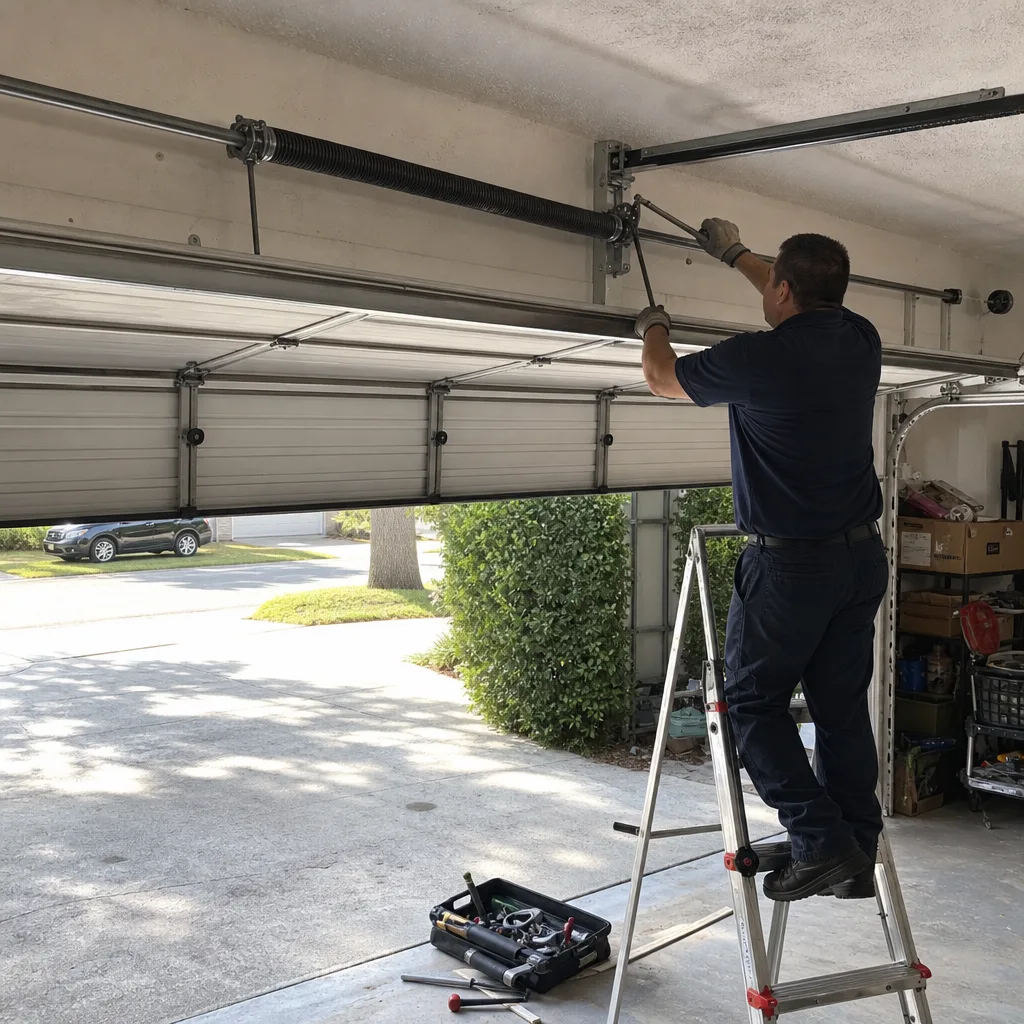
Sounds are only half the story. The way the door moves tells you whether the problem is in the door itself or in the opener that drives it. These movement symptoms are the ones we see most often in Pembroke Pines homes built between 2015 and 2025, where the original builder-grade openers are now seven to ten years old.
Hesitation at the start of travel. The door sits still for half a second after you press the button, then jerks into motion. That hesitation is the opener straining against resistance. In most cases, the resistance comes from the door, not the motor: a torsion spring that has lost tension, dry rollers, or a track that has shifted. The opener is pulling harder than it should. Address the resistance and the hesitation disappears.
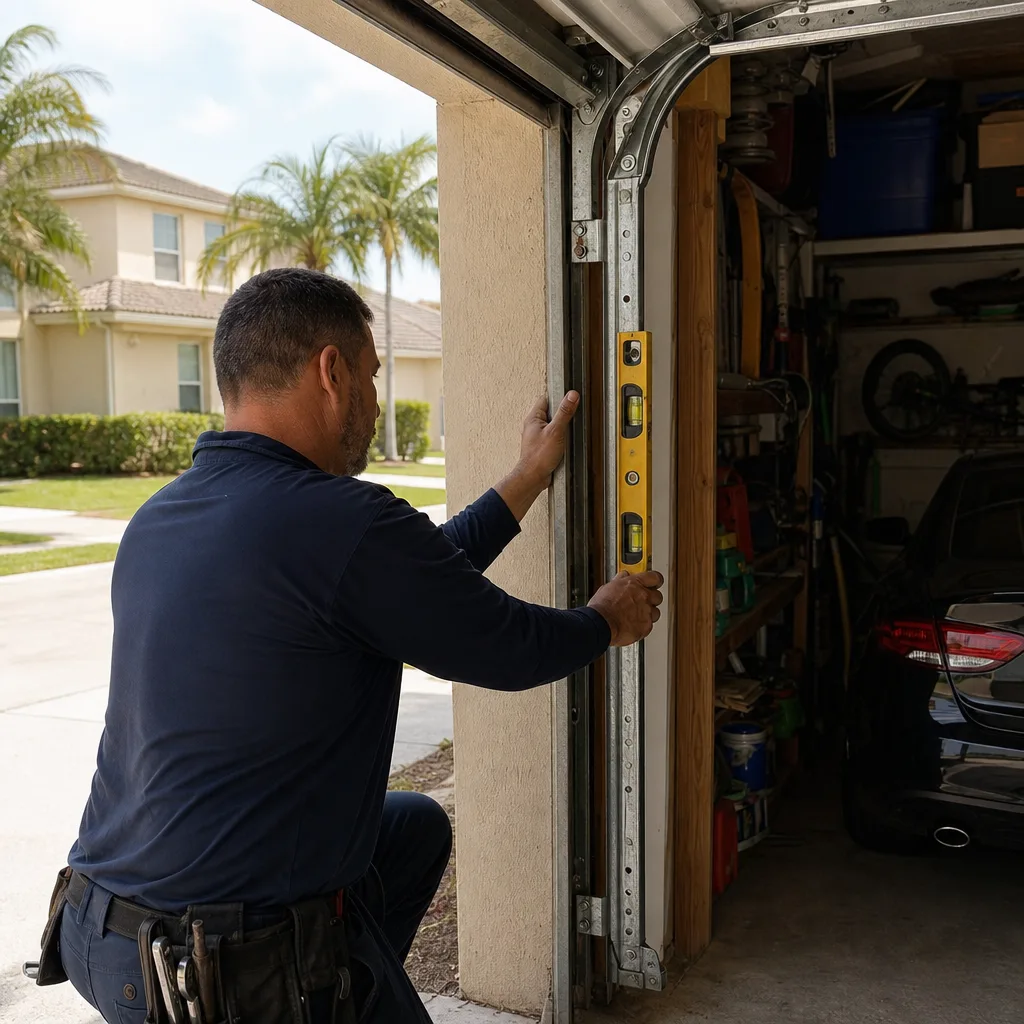
Reversal before fully closing. A door that starts closing, reverses, and returns to open is the classic “sensor problem” in most homeowners’ minds. It’s true that misaligned photo eyes will cause a reversal, but in Pembroke Pines, the more common cause is a door that’s out of plumb. The humidity corrodes the bottom bracket and the door sits slightly skewed in the opening. The safety sensors detect the skew, not an obstruction, and reverse the door. Realigning the sensors won’t fix a skewed door. The bracket needs replacement and the door needs to be re-balanced. Cost: $110 to $220.
Uneven travel: one side of the door lower than the other. Look at the bottom edge of the door when it’s halfway open. If one side is lower, the lift cables are wearing at different rates or a cable has slipped on the drum. This is a warning sign with a short fuse. Uneven travel puts stress on everything: the tracks, the hinges, the opener. When one cable finally lets go, the door drops on one side and can damage the sections. Cost to correct before failure: $140 to $260. Cost after a cable snap: $280 to $450.
The door moves in small jerks instead of smoothly. Jerky movement usually indicates a track problem. A section of track has been bent, often by a car bumper or a lawn mower handle, and the rollers catch at that spot on every pass. You can sometimes hear it before you see it. The fix is track section replacement or straightening. Cost: $130 to $240.
Visible Wear: Rust, Fraying, and Cracks You Can Spot in Five Minutes
You don’t need any mechanical knowledge to run a five-minute visual inspection. Here’s what to look at, in order of urgency.
Cables first. The lift cables run along both sides of the door and connect the bottom brackets to the torsion assembly above the opening. Look for individual wire strands poking out from the cable body. That’s called fraying, and in Pembroke Pines humidity plus the salt air that drifts inland from the coast, fraying progresses to a snap in weeks. A frayed cable is a stop-using-the-door-today warning sign. Call a professional. Do not attempt to touch or adjust cables yourself; the tension on a garage door cable can cause severe injury.
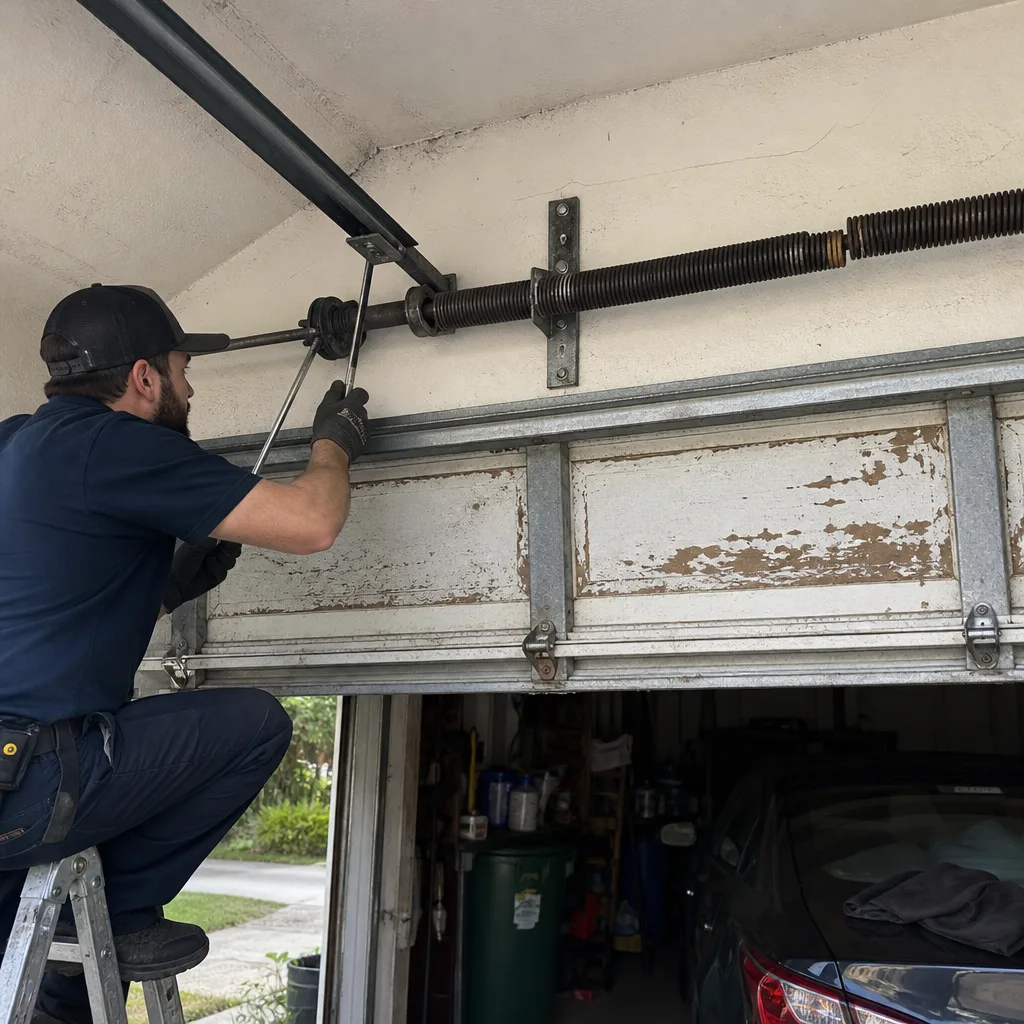
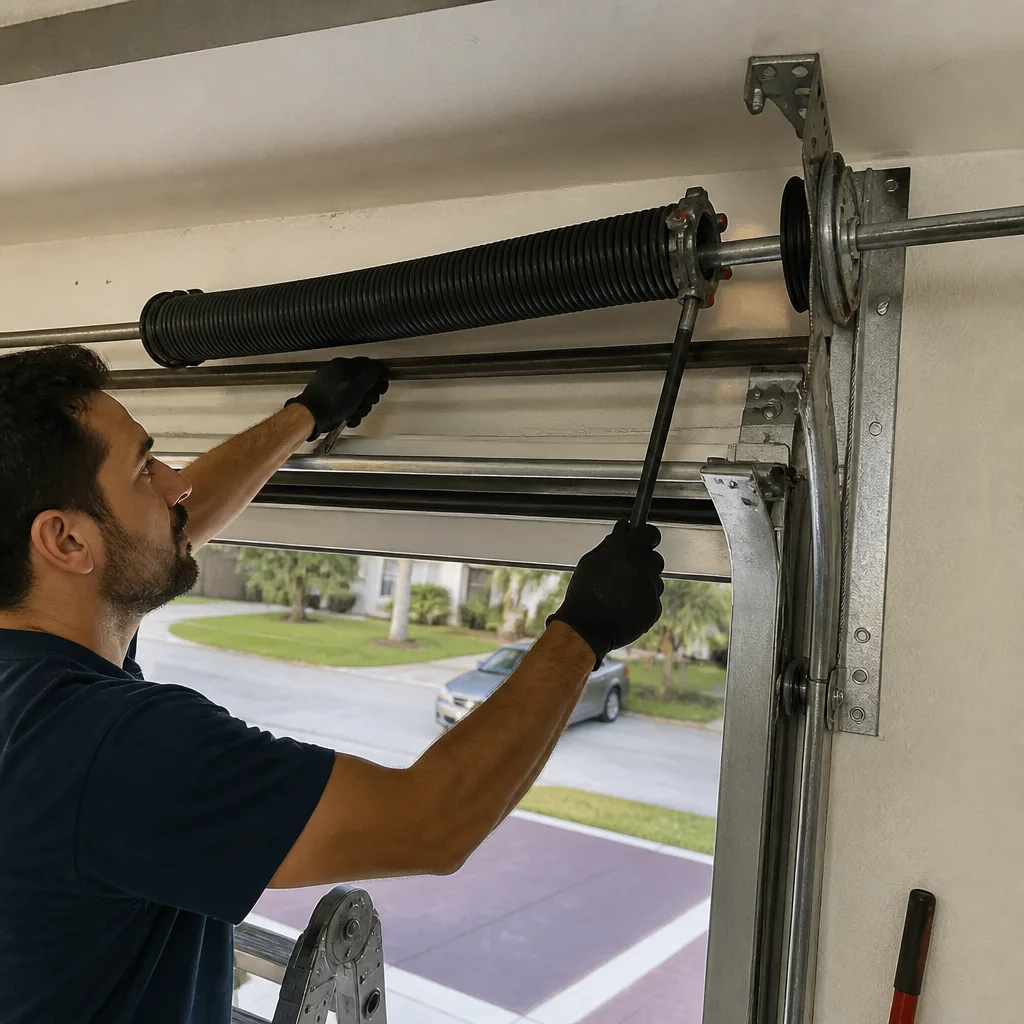
Springs second. The torsion spring is mounted horizontally above the closed door. Look for a visible crack in the coil, which appears as a dark line spiraling through the metal. Also look for a gap in the spring, which means the spring has already separated. A separated spring cannot be repaired, only replaced. Rust on the spring surface is normal in Florida and isn’t a failure indicator by itself. Cracks and gaps are.
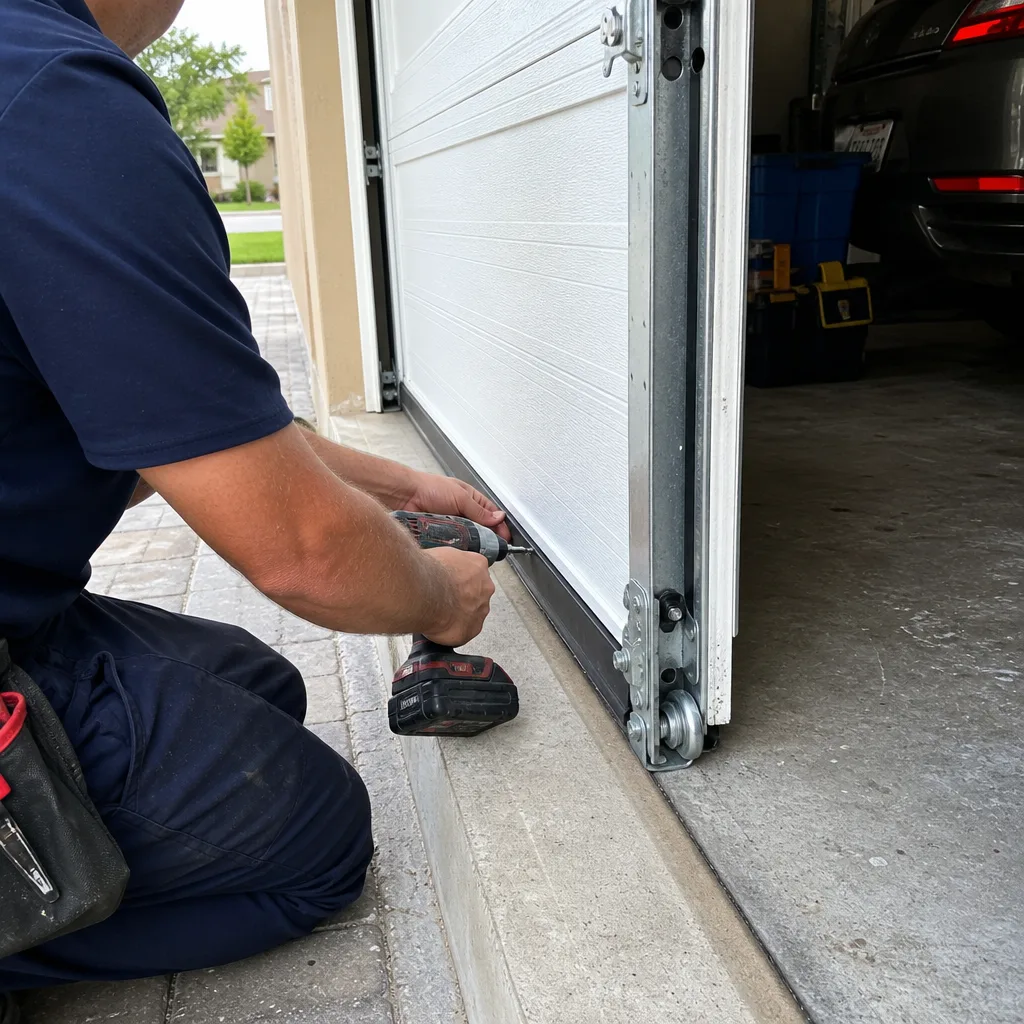
Bottom brackets third. These are the metal plates at the lower corners of the door where the cables attach. In Pembroke Pines, bottom brackets corrode faster than any other component, because they sit closest to the garage floor and get splashed every time the door goes up in the rain. Look for rust bloom, white oxidation, or flaking metal. A corroded bracket can fail suddenly while the door is in motion, dropping that corner and sending shock through the entire door. If you can brush rust off with a finger, it’s time to replace the bracket. Cost: $90 to $160 per bracket.
Panels and seals last. Look at the bottom seal (the rubber strip along the door’s bottom edge) and the weather stripping along the sides. In South Florida, UV light breaks down rubber seals faster than anything else, leaving them cracked and brittle. A failed bottom seal lets rain water, insects, and rodents into the garage. A failed side seal lets the air conditioning escape. Replacing the bottom seal costs $40 to $90. The side seal runs $80 to $140 for a double door.
Lead Time: Which Warning Signs Give You Weeks vs. Days
This is the distinction that saves money. Some warning signs are early. Others are late. Knowing which is which tells you whether to schedule service at your convenience or clear your evening.
Signs that give you weeks:
- Squealing rollers: the bearing is dry or wearing, but the wheel is intact. You have a few weeks before metal fatigue causes the wheel to seize.
- Loose hardware: hinges, brackets, and track bolts vibrate loose over time. A rattling door is annoying but not dangerous, until enough fasteners have worked out that the door shifts.
- Rust bloom without flaking on brackets: surface rust is cosmetic. Flaking rust is structural.
- Weather seal degradation: a cracked seal is ineffective but not dangerous.
- A subtle sticky spot in the door’s travel that you feel when operating the door manually.
Signs that give you days, not weeks:
- A single frayed strand on a lift cable: once one strand goes, the cable is compromised and the rest will follow quickly under tension.
- A visible crack in a torsion spring coil: a cracked coil means the spring has already begun to separate. Total failure is imminent.
- A door that suddenly sits unevenly: this means a cable has already slipped or a drum is unwinding. Component failure has begun.
- A popping sound at the same point in every cycle: a section is binding, and every pass is working a fastener or hinge closer to failure.
- A loud bang from above the door: the spring has already failed. Stop using the opener immediately and call for emergency service.
Why Pembroke Pines Humidity Accelerates Garage Door Wear
National averages on garage door component life spans don’t apply cleanly to South Florida. The heat, the humidity, and the salt content in the air compress the lifecycle of several key components. Here’s what wears out faster in Pembroke Pines specifically. For maintenance tips that address these conditions, see our Seasonal Garage Door Care for Pembroke Pines: Year-Round Homeowner’s Guide.
Bottom brackets. This is the component we replace most often in Pembroke Pines that homeowners in northern states almost never touch. The brackets sit low, get wet frequently, and the combination of standing moisture and warm air produces aggressive corrosion. In neighborhoods like SilverLakes and Pembroke Falls, where homes back up to lakes, we see bracket corrosion at twice the rate of inland subdivisions.
Roller bearings. Unsealed steel bearings lose grease to humidity. The grease becomes runny, seeps out, and the bearing runs dry. Sealed nylon rollers solve this permanently and cost only slightly more than steel.
Weather seals. UV degradation is the killer here. A bottom seal that would last five to seven years in a northern climate lasts three to four in Pembroke Pines. The rubber dries, cracks, and loses its compression set.
Opener circuit boards. This one surprises people. The logic board inside the opener is not sealed. Humid air enters through the case vents and condenses on the board when the garage cools overnight. Over years, that condensation causes trace corrosion on the board’s solder joints, leading to intermittent operation: the opener works, then doesn’t, then works again. If your LiftMaster or Genie opener is behaving inconsistently with no mechanical cause on the door itself, humidity infiltration on the logic board is the likely culprit.
Screws and fasteners. Everything that’s zinc-plated steel eventually rusts. The track mounting brackets, the hinge screws, the bracket bolts. Corroded fasteners are why a simple hinge replacement sometimes turns into a bracket replacement: the screws strip out on removal. The fix is using stainless fasteners on replacements, which cost pennies more and never corrode.
How to Photograph a Warning Sign for Remote Diagnosis
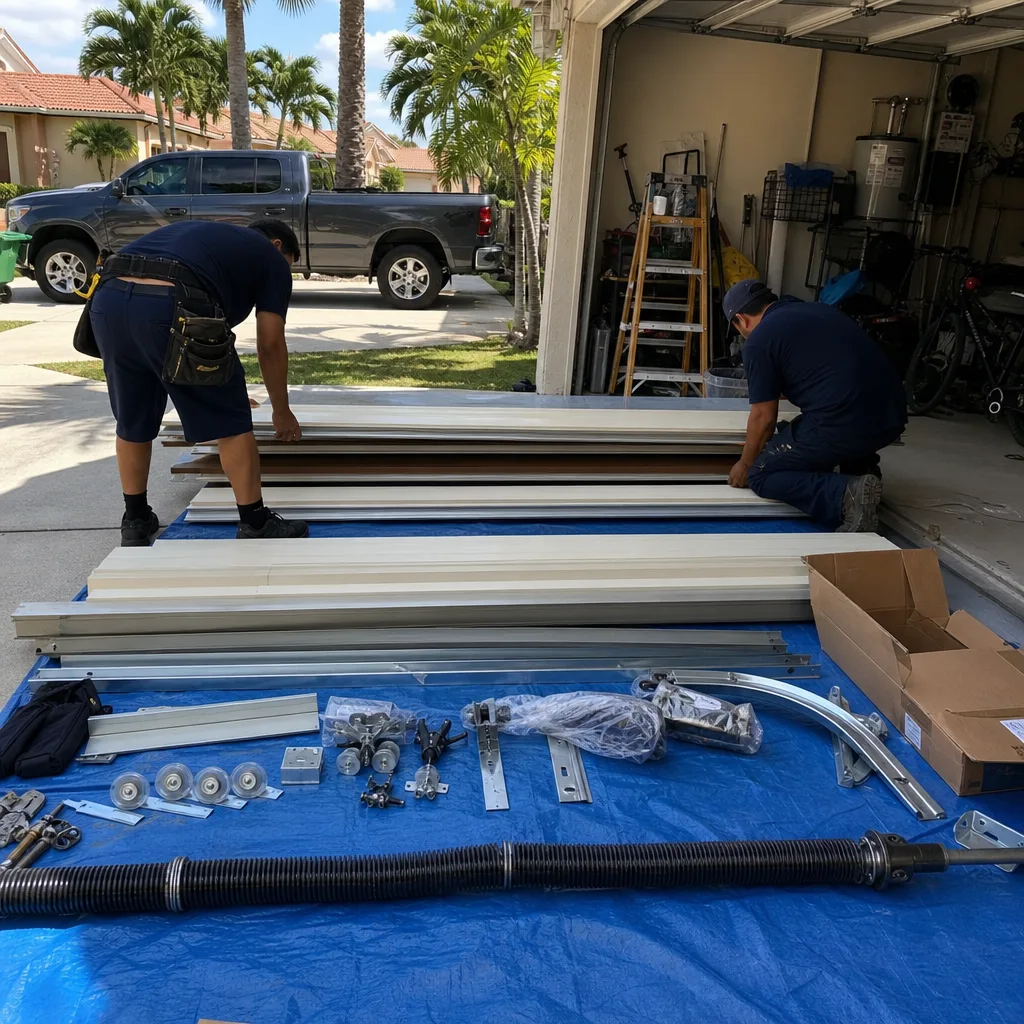
A well-taken photo saves a diagnostic trip and gets you a faster answer. Here’s how to photograph each warning sign so a technician can assess it accurately from the image alone.
1. Step back far enough to frame the whole component, not just the damage. A photo of a frayed cable that fills the entire frame doesn’t tell us where on the cable the fray is, or what the bracket below it looks like. Include the full cable run from drum to bracket.
2. Use natural light whenever possible. Shoot with the garage door open and natural light coming in. Flash photography washes out rust and highlights the wrong surfaces. If you need a flashlight, angle it across the surface, not straight at it. Side lighting reveals texture.
3. For visual wear, hold a coin or a key next to the damage. A penny provides instant scale. Without a reference object, a surface rust spot looks identical to a structural crack. With a penny in frame, the technician can see exactly how large the issue is.
4. Photograph the same component from two angles. One straight-on and one from the side. The side angle reveals depth, which is the difference between a surface rust bloom and a component that’s warping.
5. For movement issues, take a video instead of a photo. A five-second video of the door traveling captures the sound and the motion together. This is the single most useful piece of documentation you can send. It answers whether the noise is rhythmic, where in the travel it occurs, and how the door moves when it happens.
6. Capture the door in context. Frame the photo so it includes both the problem area and a reference point on the door itself, like a hinge or panel seam. This shows whether the issue has shifted adjacent components.
At Servo Garage Doors Pembroke Pines, we built this philosophy into our system. Our technicians photograph the failed component before quoting a replacement, and every customer receives the photo record at the end of the visit. It’s Clause 4 of The Haven Standard, and it traces back to the rule our owner set in 2015: no one replaces a part they haven’t seen themselves.
Three Symptoms Homeowners Misattribute to the Opener
The opener is the most visible machine in the system, so it gets blamed for everything. But the opener is just the motor. It only pulls. When something else in the system fails, the opener is the part that complains, and homeowners assume the opener is broken. Here are the three most common misattributions we sort out in Pembroke Pines.
1. “The opener is struggling to lift the door.” The door is heavy, and the springs do the lifting. The opener is a motor with a gear train; it moves the door, but it doesn’t carry the weight. If your opener sounds strained, it’s because a spring has lost tension. The spring carries the load, not the motor. Replacing the opener won’t fix a bad spring. Replacing the spring fixes the strain.
2. “The door reverses every time it closes, so the sensors must be broken.” The sensors are rarely the problem. The door being out of plumb is the problem, and the sensors are doing their job by detecting an anomalous condition. In Pembroke Pines, the root cause is usually a corroded bottom bracket that has shifted the door slightly, so the safety beam detects the misalignment as if it were an obstruction. Fix the bracket and the reversal stops. If a technician realigns the sensors without addressing the door, the problem comes back within weeks.
3. “The opener runs but the door doesn’t move.” That’s the trolley carriage, the component that connects the opener rail to the door. It wears down its internal teeth over five to seven years. When it fails, the motor runs, the chain or belt moves, but the door doesn’t. Homeowners replace the entire opener, when a trolley carriage replacement is a $140 to $220 repair. Unless your opener is also old, worn, or from a brand we know has parts availability issues, a carriage replacement extends its life another five years.
What Each Warning Sign Costs to Fix in Pembroke Pines
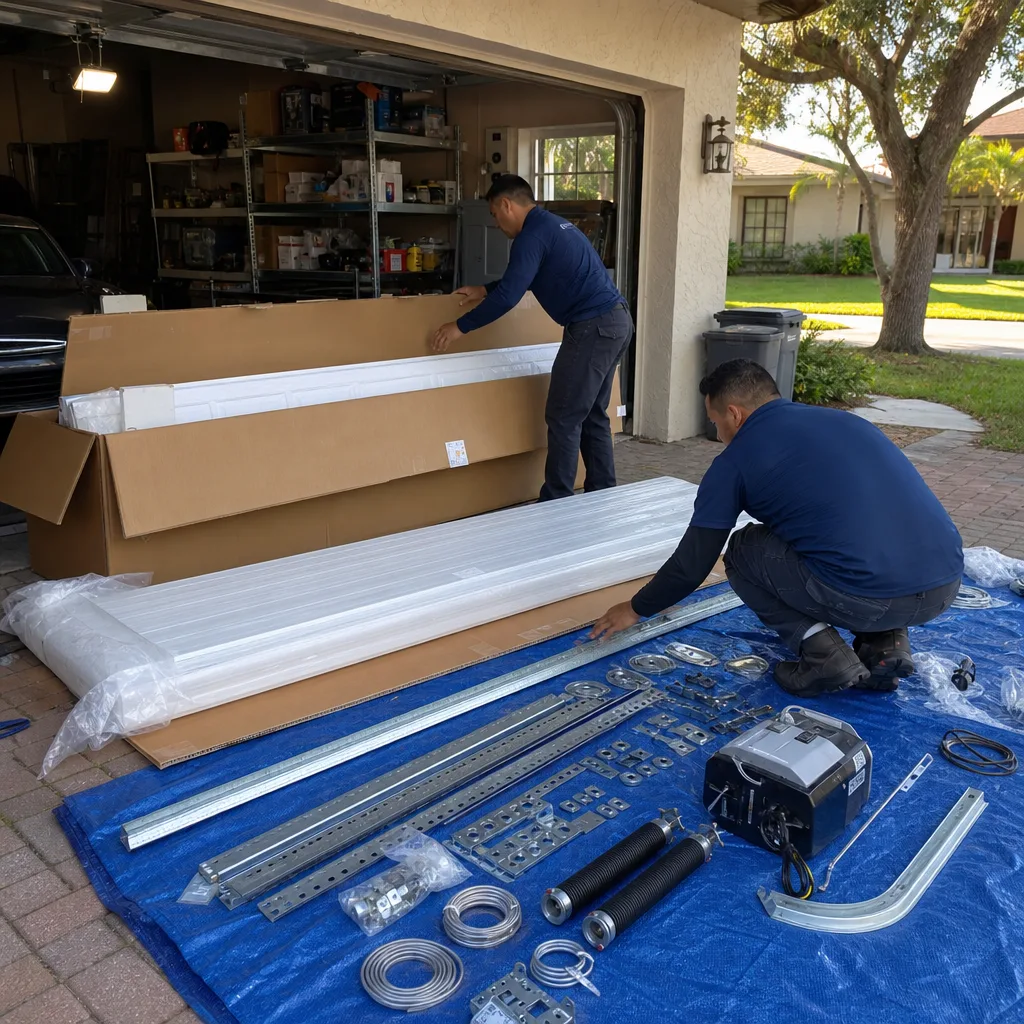
Here’s the full cost map. These are the ranges we quote in Pembroke Pines, where an independently owned operator like Servo keeps overhead low enough to price repairs without padding. For more guides & resources, visit our blog.
- Roller replacement (all rollers): $85 to $160
- Hinge replacement (one hinge): $45 to $80
- Bottom bracket replacement (one bracket): $90 to $160
- Spring replacement (torsion, one spring): $180 to $340
- Cable replacement (both cables): $140 to $260
- Track realignment or section replacement: $130 to $240
- Weather seal replacement (bottom): $40 to $90
- Trolley carriage replacement: $140 to $220
- Logic board replacement: $150 to $260
- Full opener replacement: $380 to $650
Every one of those numbers is a written, flat price agreed to before any work starts. That’s Clause 1 of The Haven Standard. There’s no “call for a quote.” The technician arrives, photographs the failure, shows you the photo, and presents the written scope and the written price. You approve it or you don’t. Either way, you have the documentation in hand.
Common Mistakes to Avoid
- Ignoring a squeal for months. A dry bearing on a roller will eventually seize. A seized roller drags on the track and wears a groove into the rail. That’s a $40 roller that becomes a $180 track repair because it was ignored.
- Lubricating a worn-out part instead of replacing it. Spraying lubricant on a roller with a failing bearing or a hinge with a cracked barrel quiets the noise temporarily and buys you a week. The part is still failing. The lubrication just masks the symptom.
- Trying to fix a cable or spring yourself. Torsion springs and lift cables are under several hundred pounds of tension. A spring that lets go while you’re working on it can kill you. Genuinely. This is the one repair where the safety warning is not boilerplate. Call a trained professional.
- Replacing the opener when the door is the problem. The opener is the motor, not the lifter. If the door is hard to move manually, the problem is in the door’s springs, rollers, or tracks. A new opener won’t fix any of that.
- Waiting until a cable snaps to call. A broken cable damages all four panels and potentially the track when the door drops on one side. The $140 to $260 cable replacement becomes a $600 to $900 panel and track repair. Fraying is the warning sign. Act on it.
- Buying parts online and attempting a DIY replacement. The torsion spring for your door is sized by wire diameter, coil count, inside diameter, and door weight. Buy the wrong one and the door won’t balance. That $40 internet spring becomes a $300 re-do.
- Confusing “rust on the surface” with “rust through the metal.” Surface rust on a bracket or a track is cosmetic and can be cleaned. Rust that has eaten through the metal is structural. If you can’t tell the difference, get a photo and send it to a professional before deciding the part needs replacing.
When to Call a Professional
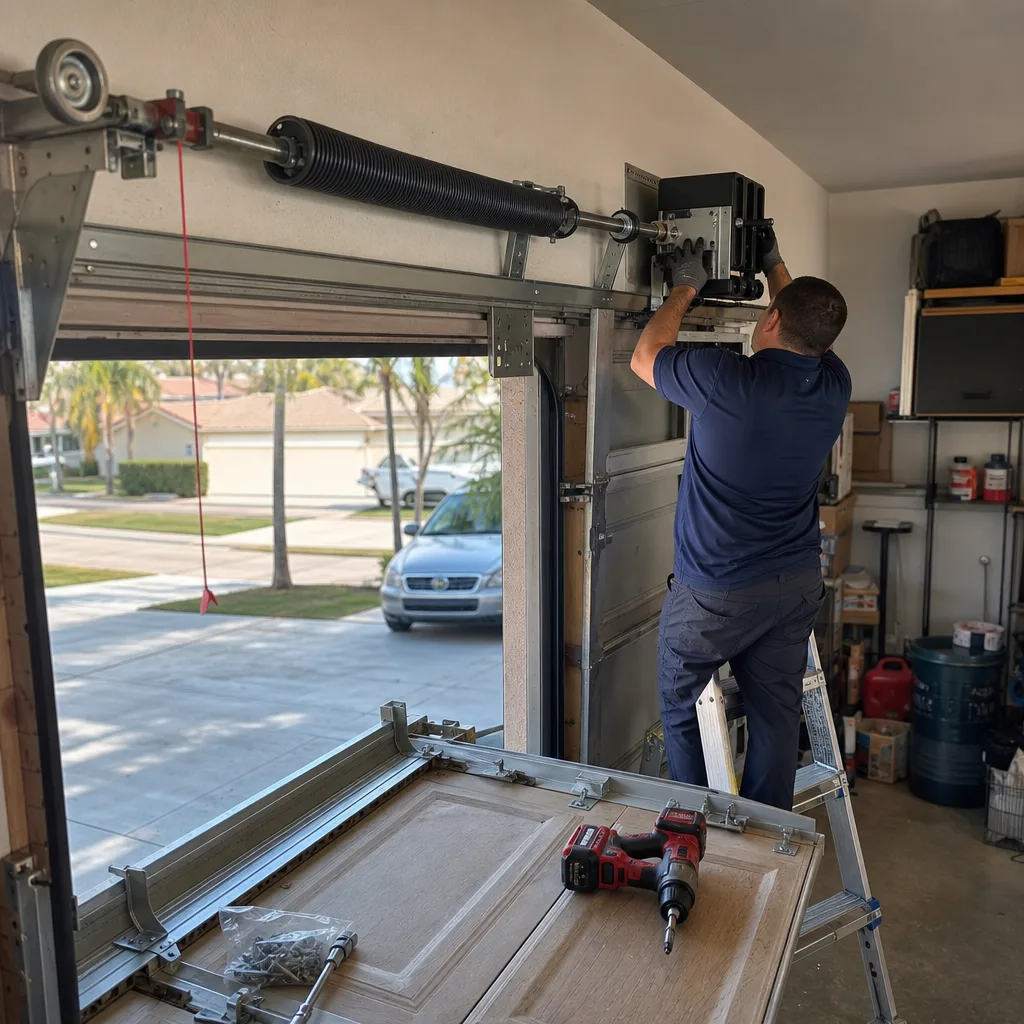
Some things are genuinely do-it-yourself: cleaning the photo eyes, lubricating hinge points, replacing the bottom seal. Others are not. If you have a frayed cable, a cracked or separated spring, a door that’s visibly out of plumb, or a bottom bracket that’s flaking rust, call someone who does this every day. The same goes for any issue involving the torsion assembly: the springs, cables, and drums above the garage door opening carry tension that can cause serious injury if released incorrectly. Servo Garage Doors Pembroke Pines offers free estimates in Pembroke Pines. Call (954) 280-1425 and describe the warning sign you’re seeing, and we’ll tell you over the phone what you’re likely looking at and whether it can wait until next week or needs attention today.
Frequently Asked Questions
The most common warning sign we see in Pembroke Pines is corrosion on the bottom brackets and a high-pitched squeal from the rollers, both caused by the region’s humidity. The squeal usually develops weeks before the bracket corrosion becomes visible, which makes it the earliest reliable indicator that a component needs attention.
Noise-related repairs in Pembroke Pines typically cost between $85 and $340 depending on the component generating the sound. A roller replacement runs $85 to $160, while a torsion spring replacement runs $180 to $340. The price is always quoted as a flat, written number before any work begins.
Most warning signs can wait a few days to a week, but three specific signs require immediate attention: a frayed cable strand, a cracked torsion spring coil, or a loud bang from above the door. Those indicate a component under tension is about to release. Stop using the door and call (954) 280-1425 for emergency service.
A garage door that reverses before fully closing is usually a skewed door, not a sensor problem. In Pembroke Pines, the humidity corrodes the bottom bracket, the door loses its plumb, and the safety sensors detect the misalignment. If you’re experiencing this, check for rust on the bottom brackets first before paying for a sensor realignment.
Our technicians carry the most commonly replaced components for all eight major brands we service: rollers, hinges, bottom brackets, cables, springs, and weather seals. If a component isn’t on the truck, you’ll know before the visit ends, along with the written price and the expected timeline for installation.
We photograph the failed component before quoting the replacement. You see the photo, the written scope of work, and the flat written price before you approve anything. That process is codified in Clause 1 and Clause 4 of The Haven Standard. No estimate is given verbally, and no work starts without your written approval.
The Bottom Line
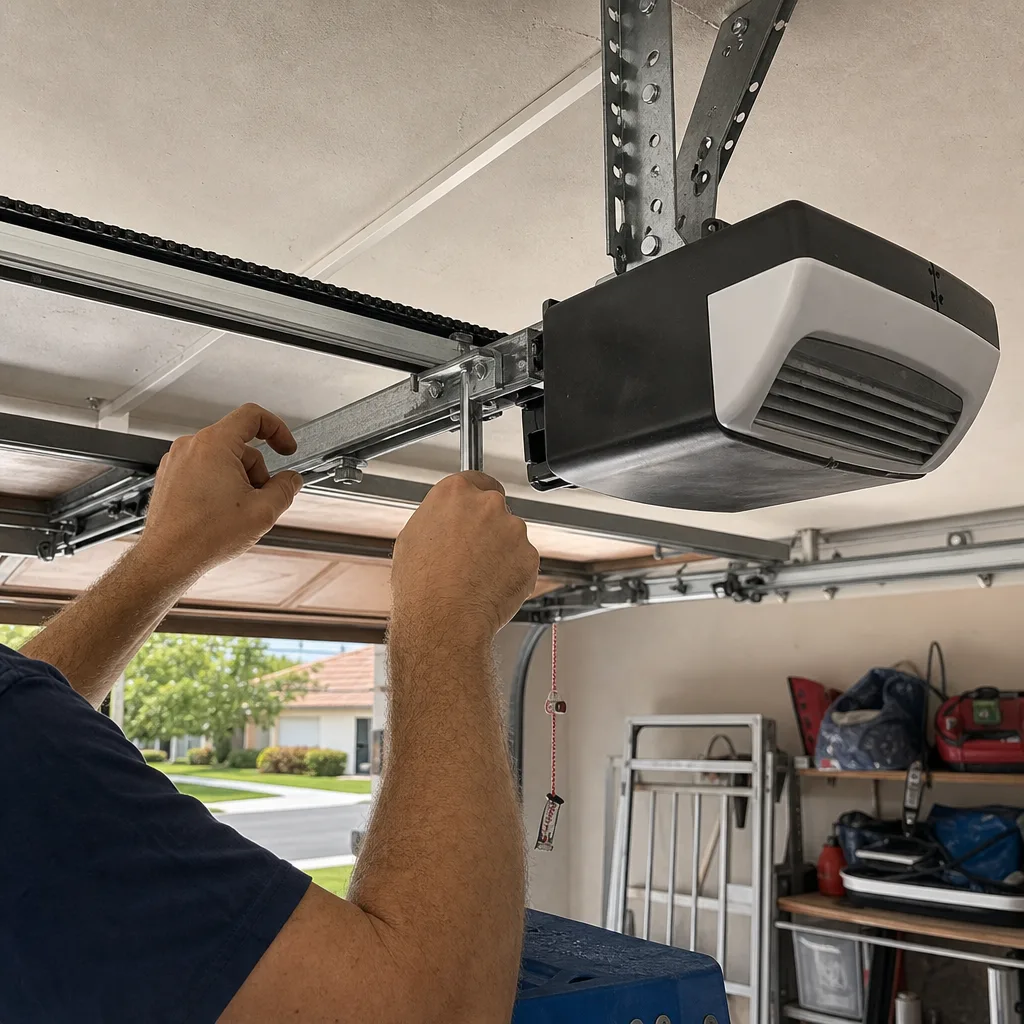
Garage doors announce their failures in specific, nameable ways. A squeal is a roller bearing. A bang is a torsion spring. A hesitation is a door resisting the opener’s pull. In Pembroke Pines, the humidity and salt air mean these warning signs appear earlier and progress faster than you might expect. Learn the sounds, watch the movement, and inspect the cables, springs, and brackets once a season. Most repairs cost between $85 and $380 when caught early. The ones that cost more are the ones that were ignored. Call (954) 280-1425 for a free estimate, a written price, and a photo record of whatever we find.
Written by Marcus Deller, Owner at Servo Garage Doors Pembroke Pines, serving Pembroke Pines since 2015.